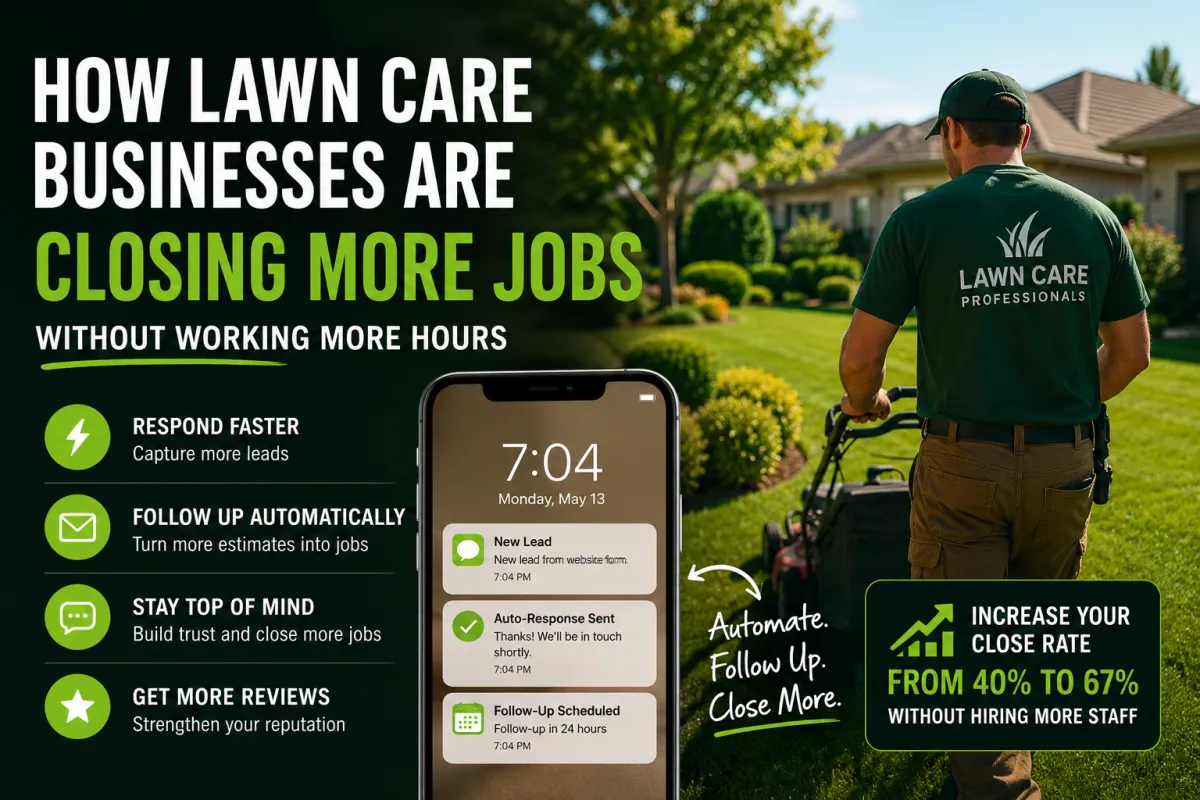
How Lawn Care Businesses Are Closing More Jobs Without Working More Hours
Most lawn care business owners aren't losing jobs because they do poor work.
They're losing jobs because someone else responded faster.
If you're managing dozens of accounts, spending your days on job sites, and still answering customer texts late at night, the issue isn't a lack of effort. It's a lack of systems.
The difference between those two things can mean thousands of dollars in lost revenue, countless hours spent chasing leads, and evenings you'll never get back.
One lawn care owner discovered this firsthand. By implementing a few simple automation systems, he increased his estimate close rate from 40% to 67% in less than 60 days—without hiring a single employee.
Here's what changed.
The Hidden Reason Most Lawn Care Companies Lose Jobs
Picture a typical day.
A potential customer fills out your contact form at 7:04 PM while you're wrapping up your final job. You don't see the notification until later that evening. After getting home, eating dinner, and catching up on a few things, you finally send a reply at 9:47 PM.
By then, the prospect has already booked another company.
Not because they were better.
Not because they were cheaper.
Because they responded first.
Research consistently shows that lead response time plays a major role in conversion rates. Yet most lawn care operators spend their days in the field, making it nearly impossible to respond to every inquiry within minutes.
That's where automation creates an advantage.
Not by replacing the owner, but by ensuring every lead receives an immediate response regardless of the time of day.
One lawn care company implemented automated lead-response and estimate follow-up workflows that guaranteed every inquiry received a response within minutes. Within 60 days, their close rate increased from 40% to 67%.
What Automation Actually Looks Like in a Lawn Care Business
The word "automation" often sounds intimidating.
Many owners assume it requires a large budget, technical expertise, or a franchise-level operation.
In reality, the systems that produce the biggest results are often surprisingly simple.
1. Automated Estimate Follow-Up
One of the biggest leaks in the sales process happens after estimates are sent.
Customers get busy. Business owners get busy. Days pass without follow-up.
Eventually, the opportunity disappears.
To solve this, we implemented a simple estimate follow-up workflow.
When an estimate is sent:
A follow-up text is automatically sent 24 hours later if the customer hasn't responded.
A second follow-up is sent 72 hours later.
Messages remain professional, conversational, and personalized.
Instead of manually chasing every estimate, the system handled the follow-up automatically.
The result? More estimates converted into paying jobs.
2. Instant Lead Response
The second issue was response time.
New inquiries often sat for hours before receiving a reply because the owner was working in the field.
The solution was simple.
Every website form submission triggered an automatic text message within minutes, whether the inquiry came in at 2 PM or 2 AM.
Prospects immediately knew their request had been received and that someone would be in touch.
That simple change dramatically improved lead engagement.
3. Automated Review Requests
Like many lawn care businesses, this company consistently delivered quality work but struggled to collect reviews.
Customers were happy. They simply weren't being asked.
We created an automated review request that was sent immediately after each completed job.
No reminders. No manual follow-up.
Within a single season, the company's review count doubled.
None of these improvements required additional employees.
They required better systems.
The Numbers Behind a Higher Close Rate
A jump from 40% to 67% may not sound dramatic at first.
But when you put real numbers behind it, the impact becomes obvious.
Let's assume you're sending 50 estimates each month with an average job value of $400.
At a 40% close rate:
20 jobs
$8,000 in monthly revenue
At a 67% close rate:
33 jobs
$13,200 in monthly revenue
That's an additional $5,200 per month from the exact same number of leads.
No extra advertising.
No larger crew.
No longer workdays.
The opportunities were already there.
The difference was simply what happened after the estimate was sent.
This is why improving follow-up systems often delivers a better return than increasing advertising spend. More leads won't solve a broken sales process. They'll simply create more opportunities to lose business.
The Trap of Becoming Your Own Bottleneck
Many home service owners eventually reach the same realization.
They take a day off and everything slows down.
Calls go unanswered.
Estimates don't get sent.
Customers become frustrated.
Revenue stalls.
When that happens, you're not running a business.
You're working a job that depends entirely on you.
I experienced this myself while growing Distinct Lawns.
For years, I was involved in every step of the operation. Every estimate, every follow-up, every scheduling conversation.
As the company grew, so did the chaos.
Adding more customers and employees didn't solve the problem because the systems weren't improving.
The real breakthrough came when I stopped handling repetitive tasks manually.
Follow-up texts.
Appointment confirmations.
Estimate reminders.
Review requests.
Seasonal customer outreach.
These activities don't require specialized expertise. They require consistency.
And consistency is exactly what systems provide.
The Seasonal Campaign That Filled Our Spring Schedule in 48 Hours
Every lawn care business knows the feeling of February.
Revenue slows down.
The phone gets quieter.
Owners start wondering when spring bookings will return.
Instead of waiting, we built a simple customer reactivation campaign.
Every past customer received a text reminding them to reserve their spot for the upcoming season before schedules filled up.
No cold calling.
No endless social media posting.
No complicated marketing campaign.
Just a simple message sent to people who already knew and trusted us.
The last time we ran that campaign, our spring schedule filled within 48 hours.
The workflow took only a few hours to build.
Yet it replaced years of manual outreach.
That's often the case with automation. The tasks consuming the most time are usually the easiest to systematize.
Where to Start First
One of the biggest mistakes business owners make is trying to automate everything at once.
That approach usually creates confusion and frustration.
Instead, focus on building systems in the right order.
Step 1: Speed-to-Lead Automation
Respond instantly to every inquiry, 24 hours a day.
Step 2: Estimate Follow-Up
Create automatic touchpoints at 24 and 72 hours after every estimate.
Step 3: Booking Confirmations and Reminders
Reduce no-shows and create a more professional customer experience.
Step 4: Review Generation
Automatically request reviews after completed jobs.
Step 5: Customer Reactivation Campaigns
Reconnect with past customers before competitors do.
Too many businesses grow in reverse.
They hire employees before creating systems.
They buy ads before fixing follow-up.
They expand operations before eliminating bottlenecks.
The correct sequence isn't exciting, but it's what creates sustainable growth.
Frequently Asked Questions
How long does it take to set up these automations?
Most foundational workflows—including lead response, estimate follow-up, and review requests—can be implemented within one to two weeks. More advanced campaigns may take two to four weeks depending on complexity.
Do I need a large operation for this to make sense?
Not at all. In fact, smaller lawn care businesses often see the biggest impact because owners typically wear multiple hats and have limited time for follow-up.
Will automated messages feel impersonal?
When written correctly, no. Effective automation feels like a personal message because it is triggered by real customer actions and reflects your company's voice.
What platform do you use?
We build most systems using GoHighLevel because it combines CRM functionality, automations, SMS, email marketing, booking pages, and reputation management into a single platform.
Should I automate before spending more on advertising?
In most cases, yes.
If your follow-up process isn't converting existing leads effectively, increasing ad spend simply increases the number of opportunities slipping through the cracks.
Can these systems work for other trades?
Absolutely.
The same automation principles apply to HVAC, pest control, roofing, holiday lighting, plumbing, and virtually every home service business.
You Don't Need a Bigger Crew. You Need a Better System.
The lawn care owner who increased his close rate from 40% to 67% didn't hire more employees.
He didn't spend more on advertising.
He didn't work longer hours.
He simply stopped being the bottleneck.
Instead of manually chasing every estimate and responding to every lead, he built systems that handled those tasks automatically.
The result wasn't just more revenue.
It was more freedom.
More time with family.
More evenings away from the phone.
And a business that could continue operating even when he wasn't actively working.
That's what automation is really about.
Not replacing people.
Building a business that doesn't depend on you being available every minute of every day.